
Paris is the most photographed city on earth, and for good reason: within a few square kilometres you can walk from a wrought-iron bridge framing the Eiffel Tower to a hidden covered arcade, a striped-column courtyard, a rose garden and a village lane that feels a century away. But knowing where to stand — and when the light is right and the crowds are thin — is what separates a snapshot from a portrait you will keep forever. We are Leda Guedes and the team behind Fotografa em Paris, a luxury photographer based in Paris for around fifteen years. This is our definitive, first-hand guide to the best photo spots in Paris for a luxury shoot: exact vantage points, the best time of day, seasonal ideas, how to avoid the crowds, and the rules you actually need to know.
How to use this guide
We have organised Paris the way we shoot it — by neighbourhood clusters that can be photographed in a single session without exhausting yourself. Each location below explains why it works, the exact spot to stand, the best light and time, the typical crowd level, and our insider tips. Further down you will find dedicated sections on the best time of day, the best spots by season, how to beat the crowds, and permits and rules. We close with a full FAQ answering the questions people ask us most.
The best Eiffel Tower photo spots
If there is one photograph everyone wants in Paris, it is with the Eiffel Tower. The good news: there is no single "best" spot — there are several, each with a completely different mood. Here are the ones we return to again and again.
Trocadéro and Place du Trocadéro
The Place du Trocadéro, on the Palais de Chaillot terrace, is the classic postcard view of the Eiffel Tower — the tower rises head-on across the Seine, perfectly centred, with nothing in the way. This is the shot people picture when they imagine Paris.
- Why it works: the raised terrace puts the whole tower in frame from base to tip, with the fountains of the Jardins du Trocadéro leading the eye toward it.
- Exact vantage point: stand on the terrace between the two wings of the Palais de Chaillot, or step down onto the esplanade for a cleaner foreground. Move slightly left or right of dead-centre for a more elegant, less symmetrical composition.
- Best time: sunrise, without question. Around dawn the terrace is nearly empty, the light is soft and golden, and you can shoot freely. By mid-morning it is one of the busiest spots in the city.
- Crowd level: extremely high after 9–10am and at sunset; blissfully quiet at first light.
- Tip: the tower's golden lights sparkle for five minutes on the hour after dark — a magical detail for blue-hour and evening portraits.
Pont de Bir-Hakeim
The Pont de Bir-Hakeim is our favourite bridge in Paris and one of the most cinematic backdrops anywhere. Its double-deck iron structure, with a Métro line running above and rows of ornate pillars below, frames the Eiffel Tower down its central walkway.
- Why it works: the repeating arches and pillars create natural depth and leading lines that pull toward the tower — a photographer's dream for portraits, engagements and fashion.
- Exact vantage point: the lower pedestrian level running along the bridge's centre gives you the columns on both sides and the tower framed at the end. The staircases and the nearby Passerelle Debilly offer alternative angles.
- Best time: sunrise or early morning. The rising sun comes from behind the tower and glows through the ironwork.
- Crowd level: increasingly popular, so early is essential. Be mindful of cyclists, joggers and the road on the upper deck.
- Tip: a passing Métro train on the upper level adds motion and a very Parisian energy to the frame.
Avenue de Camoëns
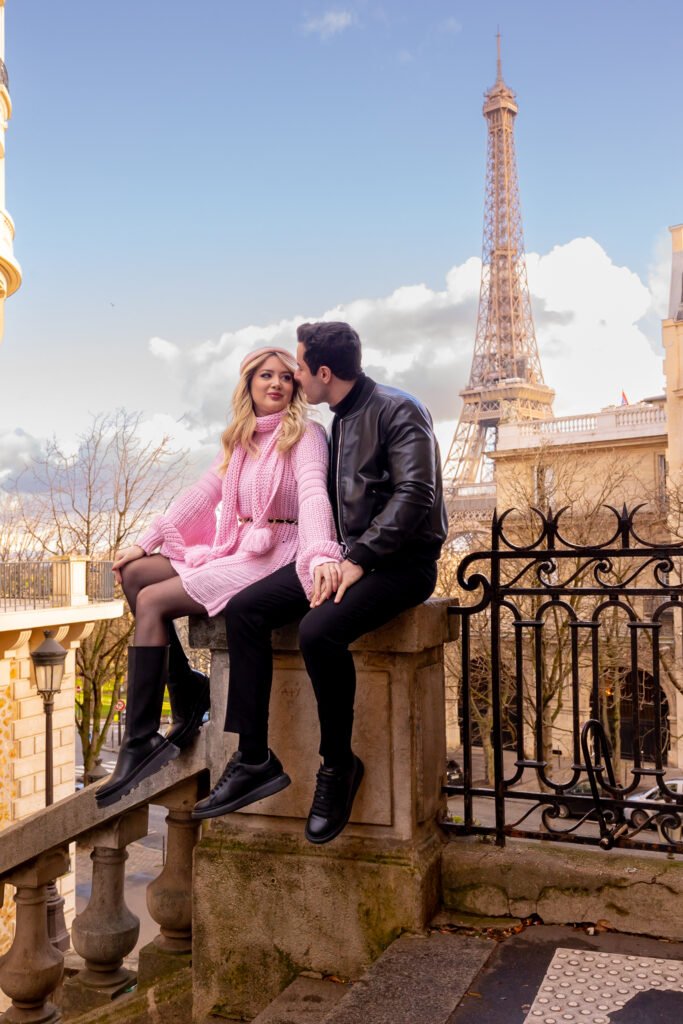
This short, aristocratic avenue in the 16th arrondissement is a hidden gem. It ends in a small balustraded terrace and staircase that frames the Eiffel Tower between two rows of Haussmann buildings — grand, quiet and far less crowded than Trocadéro.
- Why it works: the classic Parisian architecture on either side creates a refined "corridor" that leads straight to the tower.
- Exact vantage point: the balustrade and steps at the western end of the avenue. Shoot from the top of the steps looking down, or from below looking up.
- Best time: early morning for empty streets and warm side light.
- Crowd level: low to moderate — one of the best crowd-to-view ratios in the city.
Rue de l'Université
On the Left Bank, the Rue de l'Université offers the quintessential "Eiffel Tower peeking down a Parisian street" shot, complete with cafés, balconies and a real neighbourhood feel.
- Why it works: the tower appears to rise directly out of a residential street, giving an intimate, lived-in Paris rather than a tourist monument.
- Exact vantage point: the stretch near the corner of Rue Jean Nicot and Rue de Monttessuy, looking west toward the tower.
- Best time: sunrise to mid-morning, before traffic and delivery vans fill the street.
- Crowd level: moderate and growing; go early.
Champ de Mars and the Trocadéro gardens
The Champ de Mars is the great lawn at the foot of the Eiffel Tower — the place to be with the tower towering above you. The Jardins du Trocadéro, on the opposite bank, give you the tower reflected in fountains and framed by greenery.
- Why it works: the Champ de Mars offers full-length, base-to-tip shots and relaxed picnic-style portraits; the Trocadéro gardens add water, statues and trees.
- Exact vantage point: on the Champ de Mars, walk a few hundred metres back from the base for the whole tower in frame; the side alleys under the trees give soft, private light. In the gardens, the terraces beside the Warsaw Fountain are ideal.
- Best time: golden hour for warm grass and long shadows; sunrise for solitude.
- Crowd level: high near the base, much calmer along the outer edges and tree-lined paths.
Along the Seine: bridges and grand perspectives
Pont Alexandre III
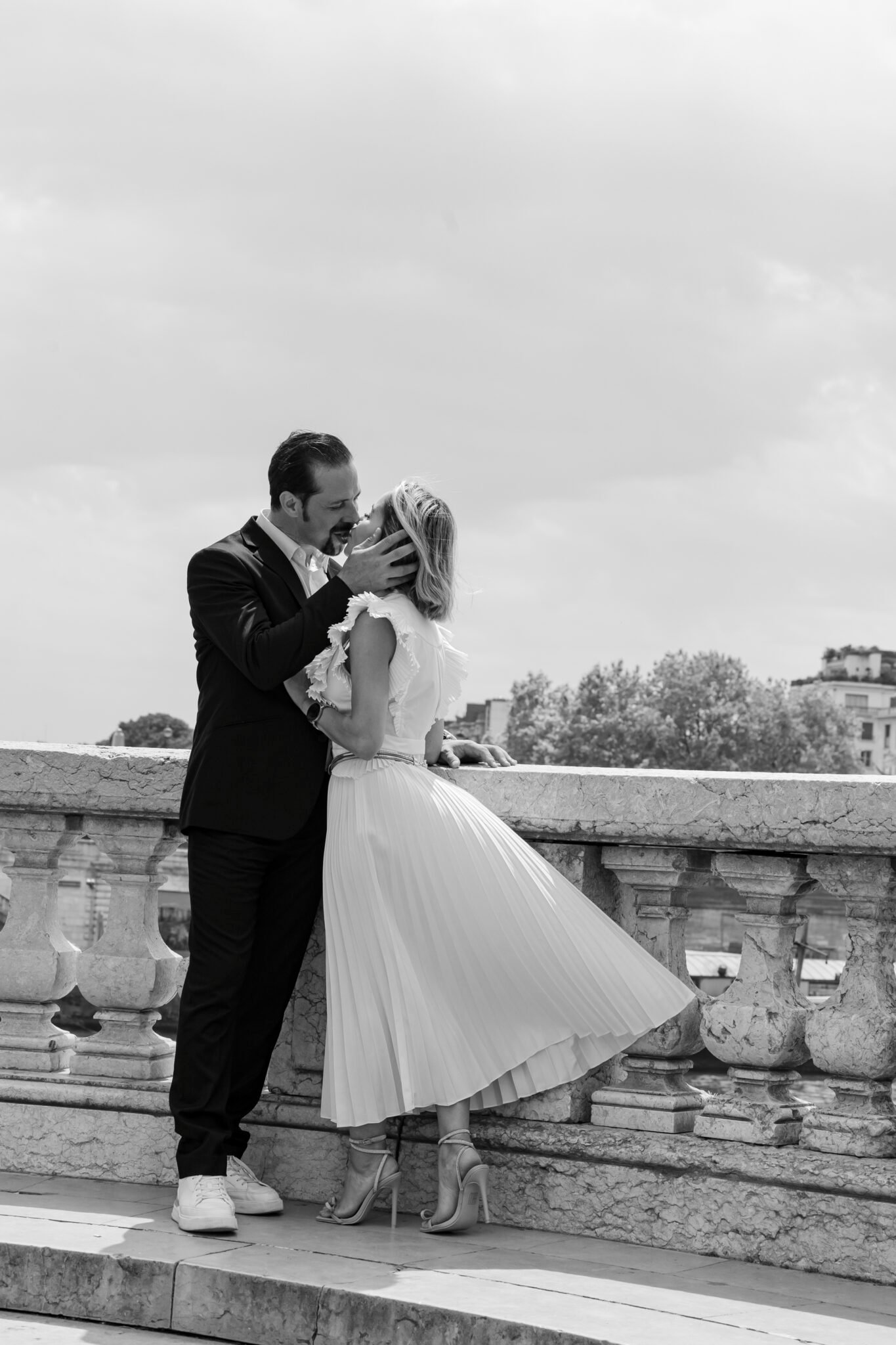
The most ornate bridge in Paris, the Pont Alexandre III is pure Belle Époque splendour: gilded statues, ornate lamp-posts, cherubs and sweeping views toward Les Invalides on one side and the Grand Palais on the other.
- Why it works: the golden Art Nouveau lamp-posts and winged horses make an instantly luxurious, editorial backdrop — perfect for evening gowns and formal portraits.
- Exact vantage point: beside the gilded statues at either end for the lamp-posts and gold detail; on the lower quays for the arches and the river. The steps down to the water offer a quieter, elegant angle.
- Best time: blue hour, when the lamps switch on and the sky turns deep blue — the single most romantic light on this bridge. Sunrise also works beautifully and is far emptier.
- Crowd level: high at sunset; manageable at sunrise and on the lower quays.
Île de la Cité and Pont Neuf
The historic heart of Paris. The Pont Neuf — despite its name, the oldest standing bridge in the city — connects to the Île de la Cité and the leafy tip at Square du Vert-Galant, right on the water.
- Why it works: timeless stone bridges, the Seine, and views toward the Louvre and the spires of the old city give a deeply romantic, historic backdrop.
- Exact vantage point: the semicircular stone bays of the Pont Neuf; the garden at Square du Vert-Galant for a low, waterside angle; the quays along the island for reflections.
- Best time: golden hour and blue hour, when the stone glows warm and the river reflects the sky.
- Crowd level: moderate — the island's quieter lanes are easy to have almost to yourself.
The Louvre and Palais-Royal district
The Louvre: pyramid, Cour Carrée and Passage Richelieu
The Louvre is far more than the glass pyramid — though the pyramid alone offers several distinct shots.
- The pyramid: shoot it head-on for symmetry, reflected in the fountains around it, or use the smaller inverted and side pyramids for graphic compositions. At blue hour the glass glows from within.
- Cour Carrée: the older, enclosed stone courtyard behind the pyramid is elegant, symmetrical and almost always quieter — a refined, crowd-free alternative with a central fountain.
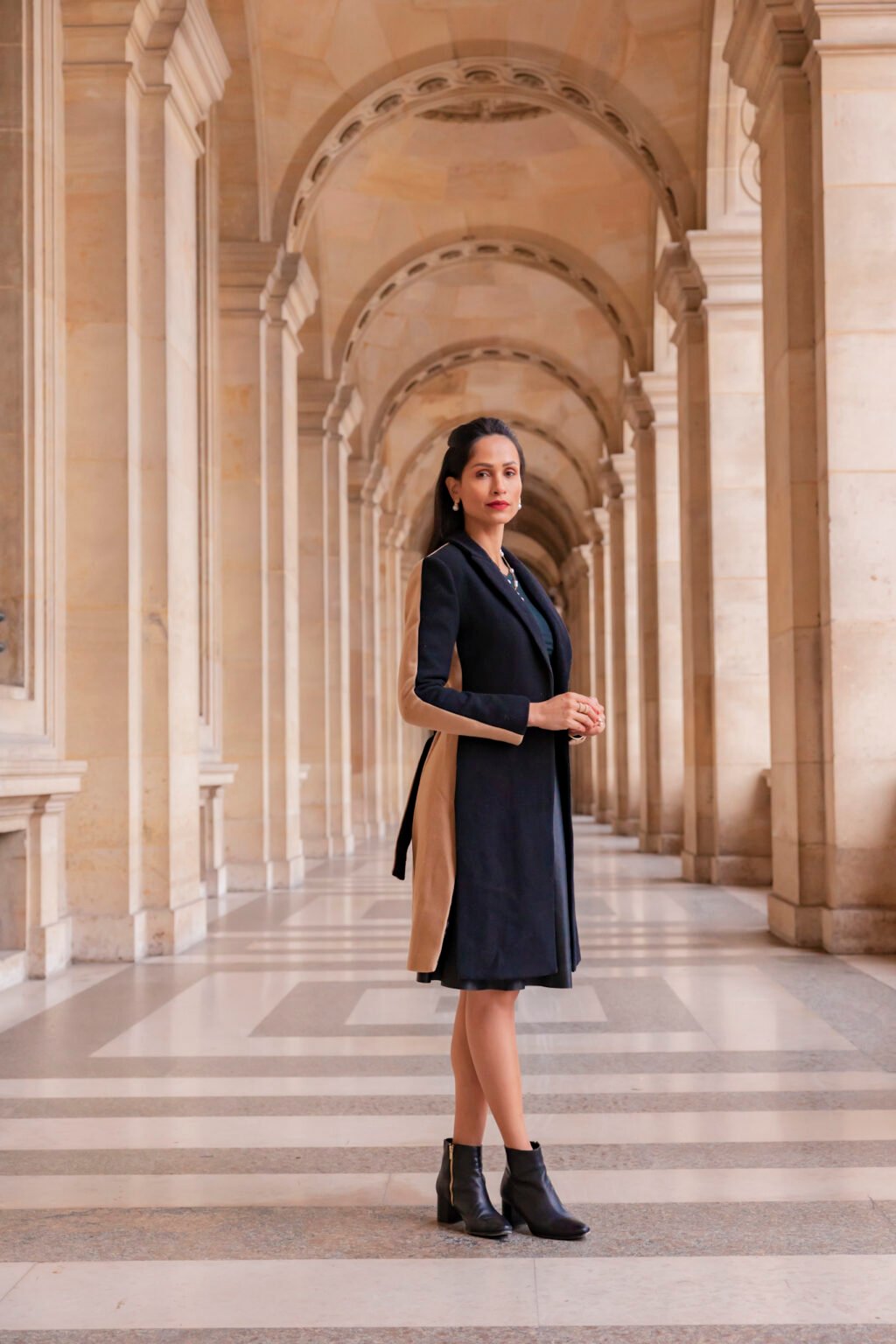
- Passage Richelieu: this covered passageway lets you frame the pyramid through grand stone arches, with the courtyard beyond. The arches create beautiful depth and shelter from rain.
- Best time: sunrise for an empty main courtyard, or blue hour when the pyramid and lamps are lit.
- Crowd level: the main courtyard is extremely busy by day; the Cour Carrée and early mornings are the secret.
Palais-Royal and the Buren columns
A few steps from the Louvre, the Palais-Royal hides two treasures in its courtyards: Daniel Buren's Les Deux Plateaux — the famous black-and-white striped columns — and a serene arcaded garden.
- Why it works: the graphic striped columns are strikingly modern and endlessly Instagrammable, while the garden's arcades and fountains are calm and romantic.
- Exact vantage point: sit or stand on the taller columns for playful, elevated shots; use the reflecting pools for mirror images. The rose-lined garden and the yellow-and-red arcade shopfronts are gorgeous backdrops.
- Best time: early morning — the courtyard is genuinely empty at sunrise and fills quickly after.
- Crowd level: very high midday; peaceful at opening time.
Galerie Vivienne and the covered passages
Paris's 19th-century covered passages are a photographer's secret weapon: elegant glass-roofed arcades with mosaic floors, antique shopfronts and warm, diffused light — and shelter when it rains. The Galerie Vivienne is the most beautiful, with its neoclassical décor and sweeping mosaic floor.
- Why it works: soft overhead light, rich period detail and vanishing-point perspectives make effortless, painterly portraits.
- Exact vantage point: the central rotunda and the long mosaic corridor of the Galerie Vivienne; nearby Galerie Colbert and Passage des Panoramas offer more.
- Best time: mid-morning on a weekday, before shops draw crowds. Overcast days are ideal here.
- Crowd level: low to moderate — a wonderful rainy-day and winter option.
Gardens and green Paris
Jardin des Tuileries
Stretching between the Louvre and Place de la Concorde, the Tuileries is grand, symmetrical and quintessentially French, with statues, fountains, tree-lined alleys and the famous green metal chairs around its ponds.
- Why it works: formal geometry, classical statues and long avenues give a timeless, luxurious feel; the round ponds reflect the sky.
- Exact vantage point: the octagonal basin near Concorde; the tree alleys for dappled light; the green chairs for relaxed, candid portraits.
- Best time: golden hour, when light streams down the alleys.
- Crowd level: moderate; the side alleys are always calmer than the central axis.
Jardin du Luxembourg
The Left Bank's most beloved garden, framed by the Luxembourg Palace, with a grand central pond, ornate balustrades, statues and manicured lawns.
- Why it works: refined, romantic and beautifully maintained in every season — palace, fountains and flowers all in one place.
- Exact vantage point: the main basin in front of the palace; the Medici Fountain, a shaded, ivy-draped pool that is intensely romantic; the flower parterres in spring and summer.
- Best time: morning golden light; the Medici Fountain is lovely in soft, shaded light any time.
- Crowd level: moderate; large enough that quiet corners are easy to find.
Montmartre: the village on the hill
Montmartre is a world of its own — cobbled lanes, ivy-covered façades, artists' squares and the white domes of the Sacré-Cœur crowning the city's highest point.
Sacré-Cœur
- Why it works: the gleaming white basilica and the panoramic view over all of Paris from its steps are unmistakable.
- Exact vantage point: the steps and terrace in front for the city panorama; the side streets for the domes rising above rooftops.
- Best time: sunrise, when the steps are quiet and the city glows in the east light.
- Crowd level: very high by day; peaceful at dawn.
Rue de l'Abreuvoir and Le Consulat
- Rue de l'Abreuvoir: often called the prettiest street in Paris — a gently curving cobbled lane with pastel houses, including the pink La Maison Rose café. Postcard-perfect and endlessly photogenic.
- Le Consulat: the iconic corner café with its red-and-cream façade, a Montmartre emblem.
- Best time: sunrise to early morning is essential here — these tiny streets fill with visitors fast.
- Crowd level: high from mid-morning; magical and empty at first light.
- Tip: pair these with Place du Tertre, the Rue Cortot and the Montmartre vineyard for a full village-Paris story.
Best time of day for photos in Paris
Light is everything. In Paris, three windows do most of the work:
- Sunrise / early morning: the single best time for iconic landmarks. The light is soft and golden, and — crucially — the crowds have not arrived. Trocadéro, Bir-Hakeim, Palais-Royal, the Louvre and Montmartre are all transformed when you have them nearly to yourself.
- Golden hour (the hour after sunrise and before sunset): warm, flattering, directional light — ideal for gardens, the Champ de Mars, the Tuileries and portraits everywhere. Skin glows and shadows lengthen elegantly.
- Blue hour (the roughly 20–30 minutes after sunset): the sky turns deep blue while monuments and lamps light up. This is the most romantic light for the Pont Alexandre III, the Louvre pyramid and the Eiffel Tower.
Midday, by contrast, brings harsh overhead light and the biggest crowds — best reserved for shaded gardens, the covered passages, and interiors. On overcast days the whole city becomes a giant softbox: gentle, even light that is wonderful for portraits and passages.
The best photo spots by season
- Spring (March–May): the most beautiful season for many. Cherry and magnolia blossoms bloom — the trees beside the Eiffel Tower on the Champ de Mars, the Petit Palais garden, the Jardin des Plantes and Notre-Dame's surroundings are famous for pink and white blossom. Gardens burst into flower and the light is fresh and clear.
- Summer (June–August): long days mean sunrise is very early (great for empty landmarks) and sunset is late, giving long golden evenings. Lush gardens, warm evenings on the quays, and vibrant energy — but also peak tourist season, so early mornings matter most.
- Autumn (September–November): our favourite for colour. The Tuileries, Luxembourg, the Champ de Mars and the tree-lined avenues turn gold, amber and red. Softer light, thinner crowds and cosy café backdrops make autumn ideal for warm, romantic images.
- Winter (December–February): crisp light, bare elegant trees, festive decorations and the emptiest landmarks of the year. Shorter days actually help — golden hour and blue hour fall at civilised times. The covered passages, museum exteriors and a possible dusting of snow reward those who brave the cold.
How to avoid the crowds
The most-searched frustration about photographing Paris is the crowds. Here is exactly how we beat them:
- Start at sunrise. This is the number-one trick. The same spot that is shoulder-to-shoulder at noon can be entirely yours at 7am.
- Choose the quieter alternatives. Avenue de Camoëns instead of the packed Trocadéro terrace; the Louvre's Cour Carrée instead of the main courtyard; the side alleys of the Tuileries and Luxembourg instead of the central axes.
- Go on weekdays, off-season. A Tuesday in November is a different city from a Saturday in July.
- Embrace overcast and light rain. Fewer people, softer light, and the covered passages and reflective wet cobbles become assets.
- Work with someone who knows the timing. A photographer who lives here knows which spot is empty at which hour and how to sequence a route so you are always one step ahead of the tour buses.
Permits and rules: what you actually need to know
People constantly ask whether they need a permit to photograph in Paris. Here is an accurate, general overview — always verify current rules, as they can change:
- Personal and portrait photography in public streets, squares, bridges and most parks is generally free and does not require a permit. A photographer working with a client for private portraits is normally treated as personal use.
- Tripods and professional equipment: in many public gardens (including those run by the City of Paris and the national estates) the use of tripods, large lighting rigs or clearly commercial setups can require prior authorisation, and staff may ask you to put a tripod away. Handheld shooting is almost always fine.
- Commercial and advertising shoots — for brands, fashion campaigns, or anything with crew, sets and equipment — do require official permits from the relevant authority (the City of Paris film office for public space, or the site's management).
- The Eiffel Tower's lights: the daytime structure is not restricted, but the tower's illuminations and sparkling light show at night are considered a protected artistic work, so commercial use of night images can require permission. Personal photos are not a concern.
- Interiors and private sites: museums, churches, arcades, courtyards and gardens each set their own rules — some restrict tripods, flash or professional shoots. When in doubt, ask on site.
- Drones are heavily restricted over central Paris and generally not permitted without special authorisation.
In practice, for the elegant portrait, couple, family, proposal and personal-branding sessions we photograph, the vast majority of the locations in this guide need no paperwork at all — just good timing and local know-how, which is exactly what we bring.
Frequently asked questions
Where is the best place to take photos in Paris?
There is no single best place, but the Trocadéro, Pont de Bir-Hakeim and Avenue de Camoëns are unbeatable for the Eiffel Tower; the Pont Alexandre III and the Louvre for grandeur; Montmartre and the covered passages for old-world charm; and the Tuileries and Luxembourg gardens for romance. The best spot depends on the mood you want and the time of day you shoot.
What is the best spot for Eiffel Tower photos?
For the classic head-on view, the Trocadéro terrace at sunrise. For a more cinematic, architectural feel, the Pont de Bir-Hakeim. For an elegant, less-crowded street scene, Avenue de Camoëns or the Rue de l'Université. Each gives a very different photograph.
What is the best time of day to photograph Paris?
Sunrise and the golden hour after it for soft, flattering light and the fewest people, and blue hour just after sunset for lit monuments and a deep-blue sky. We avoid harsh midday light except in shaded gardens and covered passages.
How do I avoid the crowds at the Eiffel Tower and other landmarks?
Shoot at sunrise, choose quieter alternative viewpoints, go on weekdays and out of high season, and don't fear overcast or lightly rainy days. Early morning is by far the most effective strategy.
What are the most Instagrammable places in Paris?
The Palais-Royal's Buren columns, Rue de l'Abreuvoir and Le Consulat in Montmartre, the Galerie Vivienne, the Pont Alexandre III, the Louvre pyramid and the Trocadéro are all famously photogenic. Pastel façades, striped columns, gilded bridges and mosaic arcades are the recurring stars.
Are there hidden or less-crowded photo spots in Paris?
Yes. Avenue de Camoëns, the Louvre's Cour Carrée, the covered passages like Galerie Vivienne and Galerie Colbert, the Île de la Cité's quiet lanes, the Medici Fountain in the Luxembourg garden, and the side alleys of the Tuileries all offer beauty with far fewer people than the headline spots.
Do you need a permit to take photos in Paris?
For personal and portrait photography in public spaces, generally no. Tripods and clearly professional or commercial setups in certain gardens and at some sites can require authorisation, and full commercial or advertising productions do need official permits. For private portrait sessions, most locations in this guide require no permit.
What is the best view of the Eiffel Tower?
For a full, unobstructed, symmetrical view, the Trocadéro terrace. For the tower framed by architecture, the Pont de Bir-Hakeim and Avenue de Camoëns. To be right beneath it, the Champ de Mars. For a distant skyline view, the steps of the Sacré-Cœur in Montmartre.
When is the best season to photograph Paris?
Spring for cherry blossoms and fresh gardens, autumn for golden foliage and softer crowds, winter for crisp light and empty landmarks, and summer for long golden evenings. Spring and autumn are the most photogenic overall, but every season has its own beauty.
Where can I photograph cherry blossoms in Paris?
The Champ de Mars beside the Eiffel Tower, the garden of the Petit Palais, the Jardin des Plantes, and the area around Notre-Dame are known for spring blossoms, typically late March into April depending on the year.
Is the Pont de Bir-Hakeim worth it for photos?
Absolutely — its double-deck ironwork and repeating pillars frame the Eiffel Tower like nowhere else, making it one of the most cinematic backdrops in Paris. Arrive at sunrise, both for the light and to have the walkway to yourself.
Can I do a professional photo shoot in Paris as a visitor?
Yes. Many visitors book a private session while in Paris to capture their trip, engagement, honeymoon, family holiday or personal branding. We guide you to the right locations at the right times, handle the flow, and deliver your images in a private online gallery.
Plan your Paris shoot with us
Knowing the spots is one thing; being led to the right place at the right light, posed with ease and photographed beautifully is another. Our guided sessions in English, Français, Português and Español turn this map into effortless, timeless images, delivered in a private online gallery — and we are proud to be rated 4.9★ on Google. Whether it's a couple's session at sunrise on the Pont de Bir-Hakeim, a family morning in Montmartre or an elegant portrait on the Pont Alexandre III at blue hour, we would love to plan it with you. Get in touch to plan or book your session — a quick message on WhatsApp is the easiest way to start.